Welcome!

This blog originally started life on another website, but has been transferred here in its entirity. It charts my experiences during a year of working as a surgeon in Kiwoko Hospital, Uganda - a rural mission hospital in the middle of the infamous Luwero Triangle, devastated during the civil war of the 1980s.

You might need to read the blog entries from the beginning of 2007 to get a full understanding of life as a Developing World Surgeon. The more recent posts are some more infrequent reflections! Enjoy, Steve

Friday, 14 October 2011

Camino de Santiago Day Six

The final day’s cycling was certainly the longest, and involved frequent ascents and descents as we crossed the valleys towards Santiago. There were herds of cows to negotiate and a close call with a white van around one bend at the bottom of a fast descent! A brief sandwich was taken for lunch as we pressed on closer and closer to Santiago. It got dustier and dustier which went for my throat, making the climb up Monte de Gozo much harder than it should have been due to excessive coughing and not enough breathing!


Finally we entered Santiago and made our way as a group along the one-way streets amongst the traffic to reach the Plaza del Obradoiro and the obligatory Cathedral marking the end of the pilgrimage. The crowds in the square were great and we saw several others who we recognised from the journey. All had a sense of achievement after completing a 350km ride. I made the mistake of going inside the Cathedral which was a giant shrine to all the things I dislike about Catholic and Orthodox buildings. Priests in cubicles waiting to receive your homage, giant sensors of incense, gold decorations, and crowds and crowds of tourists milling around while every so often a loud “ssshhh” noise would come, from someone wanting it to be a reverent experience... I was distinctly underwhelmed, and got out again as soon as I could.


The week finished with cold drinks followed by a final tapas meal, and then a good night’s sleep. The aching muscles were worthwhile, and some degree of fitness had been restored, along with a desire to get out more on the bicycle in Scotland where there are lots of long distance cycle paths waiting to be explored.

The journey home was completed uneventfully, and Scotland was cold, dark and wet, fully justifying the holiday to Spain where it had remained hot and sunny all week. All that remained was to book my flights for the next trip – back to Uganda in six weeks time!

Thursday, 13 October 2011

Camino de Santiago Day Five


This was a long morning ride through the Galician countryside, passing from village to village along mostly off-road tracks. There were some stony mini ascents and descents along the way before we ended up with a good downhill at the village of Portomarin. This was an original Roman village with a Roman bridge that was relocated when they built a dam and reservoir. The remains of the Roman bridge were moved stone by stone along with the church onto the hillside above. The result is an old church building surrounded by a very planned but pretty village around it, where we stopped in the square for lunch.


The afternoon started with another long and predominantly uphill road which seemed to go on forever. This wasn’t the most beautiful part of the countryside, and with hot sun beating down onto the tarmac it was fairly hard going – although there were flatter bits to break it up, which I appreciated. However, the ride improved and we started passing more and more walkers along the way as we got closer to Santiago. The day ended in Palas de Rei, with a comfortable hotel room, and a good meal in a courtyard restaurant.

Wednesday, 12 October 2011

Camino de Santiago Day Four

This day started with a long 8km climb up into the mountains to O’Cebreiro. This was a surprisingly steep minor road with a constant and persistent gradient requiring one of the lowest gears the whole way. Some of the group opted to walk the actual Camino path instead, so we did get a bit of a rest at the top of the climb. This was definitely the hardest bit of cycling in the trip, but the views at the top were magnificent, and after a bit more up and down (flat according to our guide), we came to another steep decent, this time on a fabulous winding wide road with a great surface, which seemed to go on for miles.


This was Galicia, where the landscape changed into rural farming communities with a lot of subsistence farming. The road went on towards Samos where we lunched, and some people visited the monastery. I enjoyed a simple rest instead after the efforts of the morning, and too much to eat again! We ended the day in Sarria where I was able to settle with a book in a terrace cafe alongside the river for an hour or two before we all met up for another Tapas meal in the town centre. Open air dining really is the thing in this part of Spain, and we seemed to be set up with our table in the middle of the street outside the town council offices and police station, but it was a beautiful setting, and good food and drink to end the day.

Tuesday, 11 October 2011

Camino de Santiago Day Three

It was another predominantly road-based start today with a ride around the outskirts of Ponferrada before a short stop in the town itself next to another castle. Then on along smaller roads and tracks to Villafranca, with its great views over green valleys and wooded mountains, and a bustling market in the town square.


The afternoon was surprisingly energetic with a long ride along the old road to Herrerias, twisting and turning below the new A6 dual carriageway as it crossed between the hills above. I found myself pushing hard ahead of most of the group, with John, one of our older group members, for company. One of the reasons for cycling this week was that I was unfit after little exercise for several months following an ankle injury. It was slightly disconcerting to find it hard to keep up with someone over thirty years older than me, but I think John did a lot of cycling, and besides, the exercise was what I needed. The muscles were aching that evening though, as we stayed in a beautiful stone build hotel between the mountains.

Monday, 10 October 2011

Camino de Santiago Day Two

Today started with buying picnic food – empanadas (the local version of a pasty, with either meat or tuna), bread, cheese, and of course olive oil and wine! The cycling was notable for a long late morning ascent to the Monte de la Cruz de Ferro – at 1505m, the highest point of our ride. I’d stayed at the back for the first part of the morning, so by the time we started climbing I wasn’t near the head of the group. However this gave me the opportunity to branch off onto the off-road track rather than following the road up the mountain. Slightly more challenging ups and downs, and a good excuse for not being first to the top of the hill!


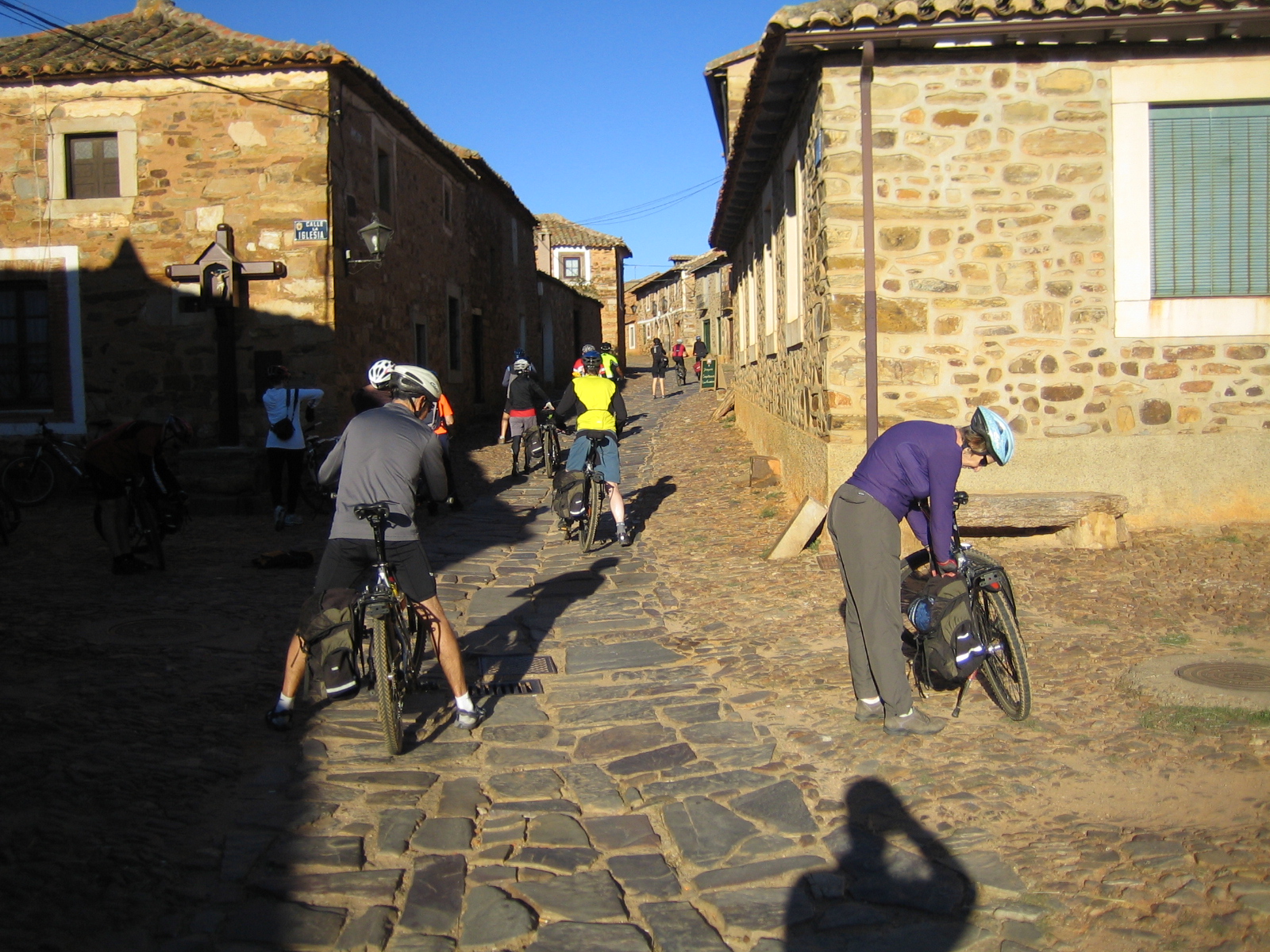
After a long rest and a prolonged picnic, the way down the other side was long and steep on roads that weren’t great. Still a good journey though, and fun around all the tight twists and bends. Pretty much the whole afternoon was downhill, ending in Molanaseca with a delightful hotel situated next to another pilgrim bridge. We were early enough to enjoy a walk around the village, followed by well earned beers outside in the shade before the sun went down. So many of the villages we passed through or stayed in had narrow streets with very few cars. They were quite delightful and picturesque, although also seeming slightly backward. It did make for a peaceful and bicycle-friendly route.

Sunday, 9 October 2011

Camino de Santiago Day One

After an early breakfast we were away on the bikes soon after nine am. Our luggage would be taken by minivan between hotels on the route, so we travel light with, for me, a small rucksack containing water, first aid kit, small toolkit, and a lightweight rain jacket. It was surprisingly cold in the early morning shade of Leon, and our first stop was in the centre with a visit to the Cathedral. This was huge and fairly spectacular, but I did hope that this wasn’t to be the pattern for the whole week. I mean cathedrals are all very well, but I was there for the cycling!


There was quite a long stint alongside the roads on the way out of Leon, but the countryside soon appeared and it turned into a beautiful day of rural cycling along small roads and farm tracks. The group seemed to keep together fairly well, with no major problems with fast cyclists and slow ones. The most spectacular part of the journey was the entry to Orbigo over a long stone bridge of Roman origin, following which we lunched. Most of the restaurants along the way did “Pilgrim” menus which were three course meals with wine/water for a fixed price. It was much needed on this first day after cycling 35km, but I was slightly concerned that I might go home having put on weight should this pattern be repeated each day!


After lunch was a leisurely (thankfully, given my full stomach) ride to Astorga. Along the way was a drinks stop in the middle of nowhere at a building which turned out to be a bit of a commune. I found myself quite challenged by one young English girl there, who had been walking the Camino but had stopped there for three weeks – when I wasn’t particularly interested in seeing round the living quarters in this commune she had a bit of a go at me for not embracing the pilgrimage and seeing “the simple life”. Obviously at her age, she was on a significant personal journey, but she walked off before I could challenge her assumptions... I mean, I’ve done the whole long journey alone thing (climbing Kilimanjaro), and I’ve done the whole living simply thing (in rural Uganda), so it would be entirely appropriate at my age to enjoy a simple cycling holiday without being judged for it! However, the brief conversation did stay with me for several days, so I guess she was successful in making me think about what I was up to!


In Astorga we settled into another hotel before exploring the old town. The main architectural feature was a very Disney-esque palace designed by Gaudi from the 19th Century. If I’m not mistaken, the castles in Disneyland/world/etc were based on this design! Dinner, after evening drinks, was in a local restaurant notable for a delightful young waitress who had the biggest smile I’ve seen outside of Uganda, even if she spoke no English!

Saturday, 8 October 2011

Camino de Santiago October 2011

Finding myself with a week of holiday in October, and with the Scottish weather rapidly turning Autumnal, I managed to be book a cycling holiday in Spain at relatively short notice. Cycling the Camino de Santiago from Leon to Santiago sounded worthwhile. The route would be on and off road along the pilgrim’s trail which has been followed for many hundred years. I actually hadn’t heard of it before, but it’s apparently one of the three great European Christian pilgrimages, along with the journey to Rome and the journey to Jerusalem. Some people would tell you that cycling rather than walking is cheating, but hey, I wanted some exercise and a cycling holiday – the fact that it’s along a pilgrim trail isn’t really important to me...

From the trip notes: “The Camino de Santiago de Compostela across northern Spain is one of the world’s oldest pilgrimage routes. For more than 1000 years pilgrims have made their way to Santiago and in 1987 it was declared the first European Culture Route. Also known as ‘The Way of St James’, it originated in the region of Galicia where the tomb of the Apostle James the Great was discovered in the 9th Century. The way is marked by the symbol of the Scallop Shell, typically found on the Galician shores, and the grooves in the shell that join together are said to represent the many different ways pilgrims travelled from to reach the tomb of Saint James....”

Easyjet actually did pretty well at getting me to Northern Spain via Stansted, along with my bag and my bicycle (considering the last Easyjet flight I went on lost my bag for five days on the way to a skiing holiday, this was great news). I even managed to watch most of the rugby world cup match with England losing to France in the quarter final while waiting between flights in Stansted. There turned out to be fifteen cyclists in our group – a good combination of single travellers and couples/friends. Unexpectedly, I appeared to be the youngest in the group – with a number of people in their forties, fifties and even sixties.

Saturday evening was a chance to get to know folks over a drink, and an evening meal of Tapas, in Leon. Bikes had been sorted out, and my bicycle put back together. With no idea of the likely fitness levels or cycling experience of my companions, the first day’s cycling was a little into the unknown, but the weather forecast suggested blue skies, sun and heat which boded well for a good trip.

Saturday, 12 February 2011

Here I go again...

...looking forward to heading back to Uganda again in May. It was too long between my last visits, so I've managed to sort things out to head back only seven months after I was last there. Of course most of my time will be spent at Kiwoko Hospital, and I've already been asked to cover the surgical workload while one of the local surgeons has a holiday!

It'll be great to see friends again too - both those in Kiwoko, and an increasing number in Kampala and surrounds, ex-pat and Ugandan. I also have lots and lots of supplies to take out - its amazing how much gets thrown out from hospitals in the UK because it can't be used, yet its perfectly good stuff and can be so useful in Uganda. This time I have boxes and boxes of sutures, plus some more endoscopy equipment and attachments for patient-monitors. Fortunately KLM allow 2 large bags in the hold of the plane!

Less than three months to go!!!

Steve

Monday, 31 January 2011

Steve In Fife...


...should really become the new title for this blog. As of 1st November I have been a Consultant General Surgeon in the Kingdom. It’s been an interesting few months settling in and seeing how things work. I feel I’m starting to get a handle on some of the issues and difficulties that reaching Consultanthood brings, particularly in my new hospital. Although the good people of Fife might object, sometimes it does feel that I’ve swapped one Third World Hospital for another in terms of some of the pathology!

My new hospital covers a population about the same size as my Ugandan hospital – about 500,000. However, where in Uganda there are on average seven doctors to run the place, in Fife we have many, many more. In Uganda there were two of us surgeons – I am now part of a team of Eleven Consultants, Fourteen Middle-graders and Sixteen House Officers. And thats just in General Surgery – there are a whole lot of other surgeons looking after Vascular Surgery, Urology, Orthopaedics, ENT, Maxillo-Facial Surgery, Breast Surgery, and Plastic Surgery. And all of us are working full time for more than 48hrs a week...

I’ve been finding my niche within the unit too. I was appointed on the basis of being a very General Surgeon with a special interest in Laparoscopic (Keyhole) Surgery and plans to take on Thyroid Surgery too. While on call I’ll therefore take almost any emergency/urgent patient, but my non-emergency workload has been predominantly hernias, gallbladders, bottoms and bowel problems. I’ve managed to do some advanced laparoscopic work – doing clever things with stones in bile ducts, and I’ve finally found a patient to do some anti-reflux surgery on, an operation I trained hard to learn last year, and which I’ve not had the chance to perform in the last six months! As I’ve not done thyroid surgery for a few years, I’ve been getting some refresher training from the other Thyroid Surgeon in the hospital – It’ll need a few more cases before I’ll feel confident to get on by myself, but I’m slowly getting there.

On the non-surgical side of things, I’ve started to take on some of the role of looking after our juniors. This is mostly rota and admin stuff, but it’s important to look after the doctors of the future, and ensure they’re getting reasonable training. I’m also starting to get involved with some of the Endoscopy administration, which is perhaps unsurprising considering my involvement setting up the unit in Kiwoko Hospital, Uganda.

My endoscopy and theatre staff have been fantastic in collecting old equipment and supplies for Kiwoko. I have boxes and boxes of sutures, suction tubes, gloves and dressings that would all otherwise have been thrown out. They’re now at home filling a corner of my study until I can take them out to Africa with me. I’m planning to go back during some leave at the beginning of May – I think I’m being lined up to help out with the surgical work load at Kiwoko while another surgeon is away! Nothing like a good holiday for relaxation!

So it’ll be back to Steve In Africa soon! I just can’t stay away from my other home, and I’m looking forward to meeting all of my Ugandan family again. Come and visit me soon, either in Fife or Kiwoko – although preferably not on a professional basis!

Steve

Sunday, 10 October 2010

I've got those post-African blues...


...now that I’m back again from Uganda after my all too brief visit over the last couple of weeks. As usual, I’m missing Kiwoko Hospital and all my Friends in Uganda greatly, and the grey, cold, damp Edinburgh autumn hasn’t been helping either. It took quite an effort to say goodbye to everyone again this time - almost a year since my last visit, and I hope it’ll not be quite so long next time before my next trip.

The Kiwoko Chase was the first highlight of my stay – the day after I arrived at Kiwoko. About 50 walkers and 80 runners took to the dirt roads around the hospital for a 16.5km race, for which I was Guest of Honour. As someone who doesn’t usually run (hill-walking and cycling are my usual activities) this was only the second time I’d run over 10km, and the heat of the morning, the sun beating down, and the altitude all combined to make it as touch a run as I remembered from my last “Chase” in 2007. I remember running up the kilometre long hill back into Kiwoko Town looking forward to turning right at the roundabout with only 500yds then left to run, and then finding out with disappointment that the route continued straight on through the town and back to the hospital by another route adding a km to the distance I was expecting! At least I was able to reach the end with enough energy left to deliver a speech and give out prizes later in the day. Many thanks to the many people who sponsored me to run – I’ve raised over £1500 for the work of Kiwoko Hospital – and there’s a link on this site if you’d still like to donate!

My busy weekend continued on the Sunday with a party and Official Opening for a Bakery which one of my friends had built. I’d helped support this venture financially, so again I was Guest of Honour! This event included a full Ugandan meal, various party games, and the obligatory speeches. Bosco John is an unusual Ugandan who manages to look forward beyond his next meal, and has provided for his family by building six rooms to rent on his property so he can get school fees for each of his six children. He currently bakes buns in a charcoal oven, but his new bakery will employ some local people as he trains them and then sends them out to sell the products. There’ll also be a small cafe which I suspect might get decent use from some of the many visitors to Kiwoko, hopefully as well as some of the locals!


Once the working week got started, it became apparent that I’d arrived in the middle of a hernia camp! Worldvision Uganda had arranged for about ninety of their children to get hernias and other minor surgical conditions fixed, and about fifteen children were arriving daily and getting operated on. We got a second operating table into the main theatre, and this allowed three of us to work on different kids simultaneously, with two of us together in the main room and a third in the minor theatre. I’d brought some oxygen sats probes with me which came in handy as it allowed us to monitor all three kids safely.


By the end of the week all the children had had their surgery and things quietened a bit. A friend from the UK is spending a year working as an anaesthetist in Kampala, and I was pleased to welcome her for a day to Kiwoko and show her round a rural mission hospital – I think it was an interesting and eye-opening experience for her, and fun for me to show-off my hospital! Lots of people visit Kiwoko for short periods of time, and get a variety of experiences, but its only by staying in one place for a number of months that you can really start to understand why things work the way they do in Uganda. There was a decent bunch of foreign students and other volunteers at Kiwoko while I was there, and I hope they got to experience some of the spirit of the place and the people who live and work there. I think many of them realised why I go back again and again...

My second weekend was spent visiting friends in Kampala. I took Mark and Helen out for dinner in a local Thai restaurant which was a novel experience for them. We were able to join up with my anaesthetist friend and her housemates to make it a very Western experience! I’d managed to plan meetings with Zai, Maureen and Christine on the Sunday, which although logistically complicated worked well, and I was taken to visit Maureen’s new hospital in Kampala. I sponsored her through her nursing training, and it’s really good to see her using the skills and qualifications she’s gained, and be so proud of what she’s accomplished. Emma, the other student I sponsored has also qualified, but is looking for work at the moment – she stayed on at Kiwoko to see me before heading back to her home in Kenya, hopefully to return soon when a job becomes available.

In so many ways I’m envious of my ex-pat friends at Kiwoko. Ken & Judith kindly let me stay in their spare room, and Rory, Denise & Gideon fed me well throughout my visit. It was so good to see them all again too. They get to stay in Kiwoko, and a large part of me would love to be back there more permanently. It seems that God currently wants me to stay in Scotland, however, as shortly before my holiday I had an interview for a job as Consultant Surgeon in Dunfermline, near Edinburgh, and was successful in getting what was my first choice of jobs in the UK. I complete my training at the end of this month, and it seems that I’ve been working towards this new job for the last thirteen years.


So I’ll be staying in central Scotland for the foreseeable future, although I’ll hopefully be able to visit my other home in Uganda frequently. Either way, I hope to see you soon...

Steve

Saturday, 4 September 2010

Uganda, here we go again...!


I’m excited to say that I’ve booked my next trip back to Uganda! It’s almost a year since I last visited, and I’ve been missing the place and the people greatly. The biggest problem has been fitting in holidays around my UK work – not helped by changing jobs at the beginning of August. But the flights have been booked, and I’m going at the end of September for two weeks.

There are three main reasons for this visit. Firstly, and most importantly, I’m going to visit all my Ugandan and Ex-pat friends. Mark, Maureen, Emma, and several others have been faithfully texting me throughout the year, so I need to catch up with them properly. They’ve all moved on from Kiwoko Hospital to other parts of the country (hopefully only temporarily) so I’ll need to travel a bit while I’m there. Others are still at Kiwoko, such as Debbie, Becky, Dr Peter, Dr James, and my Northern Irish friends Rory and Ken plus their families. Long-distance friendships are all very well, but its great to meet in person!

The second reason I try to visit regularly is the hospital work. Its good to contribute to the daily running of the hospital, and I usually end up working quite hard while I’m there. It gives the Ugandan Surgeons a break, and often a chance to get away for a few days, but is also pretty stimulating as I get to do all sorts of things that I wouldn’t do in the UK. I’ll also take out a load of old supplies that I’ve been collecting – from sutures and equipment to dressings and catheter bags. I’ll need to check over the Endoscopy equipment and ensure that its all working well too.

The third reason for going, and the point of heading out for the end of September, is that I’m going to be Guest Of Honour at the 2010 Kiwoko Chase. This is an annual race held by the hospital, both for fundraising and team-building purposes. When I was there in 2007, the 16km run from the local town, Luwero, almost killed me, so I don’t quite know why I’m planning to do it again – this time its a different route, but still the same distance, 16km, along the African dirt roads, in the African heat, at altitude! And afterwards, I’ll have to give a speech and present the prizes!

Actually, the prize-giving should be the fun part. Prizes range from foam mattresses to washing up bowls – all practical stuff, that the winners get really excited about! Its fantastic. I just hope I survive and have the strength left after the run. After the prize giving ceremony there may well be a barbeque – I suspect one of the local cows will be killed, butchered and eaten, washed down with various sodas!

All quite exciting, and a long way from life here in the UK. I’m currently working temporarily as a Consultant Surgeon in Fife, not far from Edinburgh. Its been interesting stepping up into the post, and in many ways I’m really enjoying it. One of the Consultants retired, so I’m doing his job until they appoint a replacement – the interviews are in two weeks, and as I’d really like to work at this hospital, I hope I’m successful. I guess it all depends on other applicants, but I’d like to think I have a bit of an inside track, as they know me well, and I’m currently doing the job... Although perhaps God has other plans for me... we’ll see.

Anyway, if you’d like to support Kiwoko Hospital by sponsoring me in the race, please visit www.justgiving.com/kiwokosteve and help to make a difference in the lives of the Ugandan people.

Steve

Monday, 21 June 2010

One Hundred Not Out!

I’m just back from a week staying in Glen Shiel in the north of Scotland – North West of the Great Glen, and on the road to Skye. Steve (a good friend from my church in Edinburgh and a fellow doctor – albeit a GP) and I were off on another mammoth walking trip, this time among the Munros of Scotland. We’ve previously had decent weeks trekking in the Pyrenees, and mountain biking in Morocco, so this week was a little closer to home!

For those not in the know, a “Munro” is the name given to one of the Scottish mountains higher than 3000ft (914m), after Sir Hugh Munro who published the first list of 3000+ft mountains in 1891. On current reckoning there are 283 such mountains, and although there is no definitive criteria for deciding which peaks are separate mountains, or “Munros”, and which are merely “Tops” of higher mountains, there is a reasonable distinction by virtue of drop in height and distance between adjacent summits, their character of the intervening ground, and the time that might be taken to go from one to the other. One challenge is to complete, or “bag”, all the Munros, and I’ve been slowly ticking off the mountains over many years.

Last week we were based in Ratagan Youth Hostel on Loch Duich, and had several fairly decent day-expeditions! Our first day was pretty damp with low cloud, so we warmed up with a small walk to the top of Beinn Sgritheall. The next day was clear with little cloud, so we decided on a more major trip. The South Glen Shiel Ridge was the aim, with seven Munros along its length. It extends for 14km, so start and finish logistics were important! Having only one car, but two bikes, we left the car at the East End, cycling down to the bottom end of the valley before locking the bikes and starting the trek. This was probably the other way round from most people, but it meant that we completed our 30km round trip at the Cluanie Inn where a welcome pint and some food waited, before collecting our bikes on the way back to the hostel.

The next day was also pretty good, and allowed for a traverse of The Five Sisters, a ridge on the north side of the valley. Viewed from Loch Duich, the mountains appear with a remarkable simplicity and symmetry of outline, but are actually another decent ridge walk. Three of the Sisters are Munros, and these were duly bagged. After these two long treks, a shorter day was called for, and in swirling mist and cloud we climbed two further mountains higher up the valley, Ciste Dhubh and Aonach Meadhoin. Steve continued to complete Sgurr a’ Bhealaich Dheirg and Saileag which I’d climbed before.

The best feature of that day was meeting a fellow walker on the hills. Gerry McPartlin is a retired GP who, aged 66, is doing a complete round of the Munros in less than three months for charity. I’d heard about him from a Doctors website, and had mentioned him to Steve on our journey up. I was therefore surprised and delighted to find him on the same mountain as us – chances of 283 to 1! He’d completed 208 Munros to that date and was expecting to finish off the last seventy-five within the next couple of weeks... A seriously good effort, and that day he did stayed ahead of us on our hills and carried on to complete the Five Sisters too.

Our final day was a scramble up the fabulous Forcan Ridge of The Saddle, which is a decent ridge requiring a bit more than the usual walking, although not really stretching to climbing! I’d been up The Saddle before about fourteen years ago, but it was good to be back and we combined it with Sgurr na Sgine, to make a total of fifteen Munros in five days for me.

The middle peak of our South Ridge Day was actually my 100th Munro, so I’m slowly getting through them. By the end of the week I was on 109. Steve’s a little way behind me, but has been walking quite a lot this year, and has now reached 102. He’s got another trip planned next month, so he’ll be overtaking me if I’m not careful! I may head to the hills tomorrow on a day off, in an effort to keep ahead – no, I’m not competitive at all!

Scotland is currently enjoying some fantastic weather, with long warm sunny days, and little rain, so I’m going to try to make the most of getting out to the hills while I can. I’ve hopefully got some more days off after some night shifts soon, and will just need to persuade a few others to join me when possible. However, I suspect it will be many years before I get to 200 not out!

Steve

Saturday, 29 May 2010

Should I Stay Or Should I Go?

So many of life’s choices involve considering whether to keep the status quo or change to something untried or untested. In the UK earlier this month we had the option to keep the government that we had, or make a change to a new one. The end result of a coalition between Conservatives and Liberals has been slightly unexpected, but I’m not disappointed, and so far most of what’s been said by the new Government has been positive. The rhetoric about reducing the scope of the state and putting more power back into the hands of society has got to be good – one aspect of life in the UK which I was greatly struck by when I returned to the UK from Uganda 30 months ago was how so much of day-to-day occurrences are overseen or regulated by the state. The number of CCTV cameras watching our daily lives is incredible, the licences or permissions required to do almost everything, and most of all the underlying charges which have to be paid to go about your daily life underpin everything. George Orwell and Aldous Huxley were truly visionary with their novels 1984 and Brave New World from which so many of their hyperbolous extremes have come to be an accepted part of normal life here.

On the other hand, Uganda has many different ways of doing things which aren’t necessarily better... Although I had no problems in this area myself, apparently many aspects of day-to-day interaction with the state require bribes in order to get anywhere. Armed police stopping cars on any whim can be slightly scary, especially when you’re seen to be rich by the colour of your skin. Mob justice can be the norm – which is possibly why crime levels in Kampala are pretty low – the standard punishment for someone caught stealing is to be beaten and stripped naked in the street!

There are however many things about life in rural Uganda that compare very favourably with life in the UK, and you’ll see from many of the previous blog postings here what I particularly appreciate. I’ve now got to within six months of finishing my UK training, and that has forced me into some more serious thoughts about what to do when my current job finishes in October. Do I stay in the UK and find a job as a Consultant Surgeon here in the NHS, or do I leave all that behind and go back to work at Kiwoko Hospital in Uganda?

I’d come to the conclusion six months ago that my best plan was to work in the UK for a couple of years at least in order to establish myself as a Consultant Surgeon, to get the large jump in experience that those first few years of independent practice can give, and to give me a much better chance of being able to come back to work in the UK if I did indeed take a few years in the Developing World. As someone with a strong Christian faith, I want to be somewhere where God can use me to best benefit others, and although I know that He’ll have a role for me wherever I end up, I’d rather be where He chooses first and foremost. I also believe that common sense is a gift from God, and that He can guide our personal desires, so it has been interesting over the last six weeks to find myself in a position where the sensible career choice would be to stay in the UK, but I actually had very little enthusiasm for doing so!

I had been feeling quite homesick for Kiwoko Hospital, after hearing lots from my friend Charlotte who has now completed her two months in Uganda, and with getting lots of other news from other friends who are there full-time, such as Rory and Denise who have just had a first baby, Ken and Judith who are considering whether to renew their contract at the hospital next year, Emma (one of my sponsored students) who has just completed her final Nursing exams, and Mark who is planning to take time away from the hospital for more studies in Kampala.

However, I’ve been in touch with some of the hospitals in my area, and one of them suddenly called me a couple of weeks ago. They discovered at short notice that they potentially will have a retirement in a few months time, and seem to be very keen for me to consider taking that Surgeon’s place – so much so that they’ve arranged with my own training director to get me sent there in August so I can work as an Acting Consultant for the last three months of my training. This will enable me to see whether this is indeed a job I would like, and let them see if I would fit within their department, prior to any job application/interview. All of a sudden, I’m excited and enthusiastic again – this hospital would give me most of the things I’m looking for from a Consultant job in terms of the type of surgery I’d be doing, and it’s in a good location not too far from where I currently live. More prayer required, methinks, but watch this space!

Of course this may all lead to another conundrum... would living nearer to that work be a good idea sooner or later... should I stay or should I go?

Steve

Sunday, 14 March 2010

Not at all jealous really...

...of my friend Charlotte who is about to head off to Kiwoko Hospital in Uganda for a couple of months on her medical elective (http://charlottegunner.blogspot.com). From what she tells me, she was completely inspired by a talk I gave about working in Kiwoko to a group of medical students two years ago who were exploring options about how to go about sorting their elective. The elective is a period of time most medical students get at some point in their final two years of university which they can use to go and work/study anywhere in the world. My own elective was in the summer of 1996 and I spent July and August in The Nazareth Hospital in Israel, and then September and October in... Kiwoko Hospital in Uganda! I’d been trying to get back for over ten years when I finally managed it by working there for the whole of 2007.

I remember some aspects of my time there as a medical student very well. I hadn’t done that much travelling before, and had absolutely no idea what to expect from Africa before I went. I think a cousin’s friend had been to Kiwoko Hospital a couple of years earlier and that’s how came to know of it. I do remember finding it very isolated for the first couple of weeks. There was one other medical student there with me from Leeds, who I fortunately got on with well. He appeared back to the house we lived in one afternoon with a bag of aubergines, very excited about finding them in the local village. “I hate aubergines!” I remember saying, much to his dismay. That comment found its way into his diary, I found later, with the comment: “I wonder if we’re going to get along!”


Kiwoko Hospital Main Building in 1996 and 2007

In those days, the postal service was the best method of communicating – mail from the UK took about a week to arrive. I did manage one phone call home, after about a month, from a call box in the main post-office in Kampala. Nowadays, with mobile phones, communication is much easier, and mobile phone reception is excellent and pretty cheap. Kiwoko also has a functioning internet connection via a satellite receiver at the nearby New Hope Orphanage. That allowed me to maintain email and blog communication when I was there, and was great at helping to source equipment and resources for the hospital.


Kiwoko Hospital Entrance 1996 and 2007

Other memories include the food – we had pretty much the same each day: rice and beans, sometimes with gravy, sometimes matoke (savory steamed banana). You had to be careful with the rice, as it had many small stone in it! At one point we had some Ugandan medical students there who shared our meals, and after one such lunchtime I found one of them, Diana, sitting beside me stroking my arm... “Hello!” I thought, but it was just that Ugandans have smooth arms, and my arm hair was amusing her greatly!

Of course the hospital has moved on since those days, and is now about twice the size. But the thing I appreciated most when there 12 years ago, and also when working there in 2007 was the ethos of the place, which hadn’t changed. Kiwoko Hospital is still an oasis of God’s love in the midst of a poor developing country – aiming to reach out in His strength to make a difference in people’s lives, physically, socially, and spiritually. The vast majority of staff are there serving God, and relying on Him day-to-day to provide all that the hospital needs. I certainly witnessed many miracles of healing (see earlier blog posts) and of finance at just the right time during my stay there.

Of course, I shouldn’t be jealous at all. I’ve had three opportunities to return for brief visits over the last two years. I have a good job here that gives me the money to support the hospital in many ways, and to sponsor several students there, as well as paying for airfares and associated costs of trips back to Uganda. I’m also just back from a superb skiing holiday in Austria, which gave me a much needed break from work as well as great exercise and intoxicating amounts of fresh air!


Schladming 2010

I'm also planning a further visit to Kiwoko later this year, perhaps at the time of the Nursing School Graduation, when I’ll be able to support the students who I’ve sponsored over the last couple of years. But I am excited for Charlotte, heading off into the unknown, and hopefully about to have a life-changing experience. Who knows, she may end up working there again at some point in the future – both myself and the current Medical Superintendent at Kiwoko Hospital were once elective medical students there in our time!

Steve

Friday, 19 February 2010

Relief And Exhaustion...

...is turning to joy and self-satisfaction! I’m pleased to report success in what will hopefully be my last exams ever. Many would say that I’m far too old to still be sitting exams, but the profession of surgery in the UK requires me to pass an ‘Exit’ exam before completing my training. Having passed, I can now add the letters ‘FRCS(Gen Surg)’ to my name in place of the basic MRCS qualification, but more importantly it means I can become a Consultant Surgeon when I finish in October later this year.

The Intercollegiate Specialty Examination in General Surgery has left me rather more stressed over the last few months than I would have admitted to myself. There are two parts – the first written part was in June 2009, consisting of a two hour multiple choice exam and a two and a half hour Extended Matching Questions exam. Having passed that, I was allowed to progress to the second Clinical exam.

I’m very much a General Surgeon. When I was in Uganda, that obviously encompassed every possible type of surgery. Here in the UK, most people choose to sub-specialise into Colorectal, Oesophagogastric, Hepatobiliary, Endocrine, Vascular, Breast, or Transplant Surgery. The exam tests both General Surgical knowledge (encompassing all of these sub-specialities) and sub-specialist knowledge. For me, sitting as a Generalist, I had to know all of the specialities to a higher level (!), although not to the full sub-specialist level.

The clinical exam itself was in Newcastle, held over two days. The Thursday afternoon had two exams – both half an hour long with two examiners, seeing actual patients. I had quite a mixed bag of conditions to discuss – a thyroid lump, a breast cancer, an incisional hernia, an abdominal aortic aneurysm, a large retroperitoneal tumour, and a post-op short bowel with ileostomy in the first part; obstructive jaundice due to retained gallstones, an incisional and an inguinal hernia, a male breast lump, an enterocutaneous fistula, a post thyroid cancer with an odd neurological syndrome, and some varicose veins in the second. You’re expected to be able to adequately speak to and examine patients, and then discuss the case in question in some detail.

The Friday exams were oral exams – an academic viva, a general surgical viva, and an emergency surgery and critical care viva. The academic exam requires an hour to read two published papers, before getting questioned for ten minutes per paper on your understanding of what the paper is trying to say. It’s all about the study design, appropriate methods, statistical tests, interpreting results and assessing whether the paper is worth taking notice of in clinical practice. The General exam was half an hour discussing Investigating anaemia, consent for hernia repair, pyloric stenosis in children and adults, bile leak after laparoscopic cholecystectomy, and clostridium difficile infection. The Emergency/Critical Care exam was a further half an hour discussing inflamed small bowel found at laparoscopy for suspected appendicitis, rectal bleeding and its investigation and emergency management, chest trauma with investigation and analgesia for flail segments, correction of coagulation after massive blood transfusion, and brainstem death.

I came away thinking I’d done well in the Academic and the Emergency/Critical Care vivas, but with no idea about the others. It’s an exam in which only about half of the candidates pass, so I was fairly concerned. Fortunately it doesn’t take them long to produce the results, and I had an email waiting for me when I got home on Monday. I can only say that I was relieved and exhausted. There was very little sense of achievement or joy at having passed, but that has developed through the rest of this week. Four of my colleagues in Edinburgh also sat the exam at the same time, and we all passed, which is a fantastic result. Another former colleague from another area of the country was unsuccessful on this occasion, but he’ll be able to sit it again.

Surgical Exams are an expensive business – the exam itself costs £1700; I went on a pre-exam course costing £1100; then there was travel and accommodation in London for the written, and in Newcastle for the clinical; Finally there’ll be an “election fee” to the Royal College of Surgeons to allow me to become a Fellow (FRCS stands for Fellowship of the Royal College of Surgeons) rather than a member (the basic surgical exam I passed ten years ago was the Membership exam). Still, it’s a hurdle that has been jumped, and I can now enjoy my last few months of training.

Of course, next up will be finding an appropriate Consultant job. There have been advertisements for posts in Elgin and Fort William, but both are a little too far away from the Central Belt of Scotland for me at the moment. I’m hoping that there may be jobs in Perth, Dumfries, Dumfermline or Forth Valley – a lot depends on other surgeons retiring. If nothing appropriate comes up, I may yet find myself back in Uganda!

Saturday, 30 January 2010

48 Hours...

... is the maximum number of hours per week that I am legally allowed to work here in the UK. The European Union have produced a European Working Time Directive (EWTD) to which all employees have to adhere, or sign an opt-out. In its infinite wisdom, the NHS has decided that although doctors-in-training were initially exempt from this rule, as of August last year, we’ve all had to comply both with average hours worked per week and with various rest requirements.

It’s a far cry from working in the un-restricted world of Kiwoko Hospital in Africa, although I actually believe I had a better work-life balance there and was generally less tired. I guess a lot of that depends on how busy the night-time workload is. Two years ago in Uganda, we generally worked 7.30am-5.30pm Monday to Friday. Then one week in three I covered surgical emergency operating outside of those hours Mon-Sun. I got a night off on Thursday, but had to work until 5pm on Saturday and covered the whole hospital overnight Sunday rather than just the surgery. The next two weeks were standard Mon-Fri only, with one extra Thursday night on call for the whole hospital.

That sounds a lot, but in general I wasn’t often called out overnight – there were occasionally emergencies before midnight, and a couple of 6.30 calls to theatre to help with a difficult Caesarean Section being performed by one of the other doctors who was struggling a bit, but in the main these weeks involved a decent amount of sleep except for the Sunday night which could end up being 4-5hrs only.

Now I’m back in the UK, the amalgamation of hospitals into larger centres, the transformation of out-of-hours healthcare to nurses answering telephones and seeing patients rather than the old model of General Practitioner doctor consultations, the reduction in training hours and therefore less experienced junior staff, as well as an aging population more prone to ill-health and with much greater 24hr expectations, has resulted in a much heavier overnight workload than was the case when I started work as a doctor over twelve years ago. The lack of expectation of sleep overnight combined with the EWTD means that I’m on shift work, and I hate it!!!! Unfortunately I’m one of those people who find it very hard to sleep during the day between night shifts, and so I get progressively more tired as my night-shifts go on.

Over the last three weeks I have worked: Friday, Saturday, Sunday nights; Monday to Friday daytime on a course 8.30-5.00; Saturday & Sunday off; Monday to Sunday Emergency Surgery shifts 8.00am-9.00pm; Monday off; Tuesday-Thursday nights. Admittedly my week’s course in the middle should have been a fourth night and then the rest of that week off, but it’s still a fairly punishing schedule. Fortunately before nights come round again I get five weeks of normal 8am-6pm Monday-Friday working. On paper it does eventually average out at 48hrs over the course of the rota, but of course in practice events require you to start earlier and finish later regularly. Life was definitely better with the old on-call one night a week and one weekend a month...

The best thing about this year is that in theory I finish my training at the end of October 2010 getting my Certificate of Completion of Specialist Training, and enabling me to register as a Specialist Surgeon and get a Consultant job. There’s the small matter of passing exams in a couple of weeks time, and then the need to find that new job. There are potentially a couple of jobs coming up in some of the medium-sized hospitals in Scotland – As a generalist with a laparoscopic surgery interest, I’m not specialised enough to go for jobs in the big city hospitals, which does limit the type of jobs available. I guess I’ll have to see what comes up, pray hard, and trust that I’ll end up somewhere I can be useful. Various things in life are suggesting to me that staying in this country initially would be better than heading immediately back out to Uganda... which is possibly what I would actually really like to do... but I’ll wait and see where God is guiding me.

One thing I am able to do much more easily from Scotland is head to the Alps to go skiing which is my next break at the end of February and hopefully a reward for getting through the exams. Anyone for Gluhwein?

Steve

P.S. The snow in Edinburgh (pictured above from Arthur’s Seat) has now all gone again. I hope spring comes soon!

Monday, 4 January 2010

A very un-African New Year

I still find myself thinking of Kiwoko Hospital in Uganda frequently, recalling the life that I lived there over two years ago with fondness. One obvious and major difference between Edinburgh and Uganda this New Year has been the weather – for once the UK has had a proper cold spell with winter weather that has now lasted over two weeks! I suspect my friends at the Equator have been suffering with the beginning of the dry season, temperatures of 28-30 degrees (Celcius), and a distinct lack of water. Here we’ve had more snow than I’ve seen in Edinburgh in over 15 years, repeated snow-falls, temperatures dropping to -14, and plenty of ice. It makes a nice change from the usual dark, wet, windy pseudo-winter that we usually suffer each year, and I’m all in favour of it, especially as it happened over Christmas.

New Year was spent in the middle of Edinburgh’s Hogmanay Street Party for the first time this century! We wrapped up well, took a hip flask of a rather nice Tobermory 10 year old, and joined the crowd for some live music, dance and banter. In fact midnight itself was seen in with a rather flamboyant Cuban band and some Latino music. And the fireworks were magnificent. It turned into a late night as we went on to another friend’s party, very handy at a flat overlooking Edinburgh Castle. I’ve had much quieter New Years in the recent past, so it’s good to remind myself that I can still enjoy myself even as I get older!!!

My friend Mark from Uganda wouldn’t have coped with the cold. I Kiwoko hospital again in October, and brought him back for a few weeks to the UK, which was a fantastic experience for both of us. It’s surprising how much you can squeeze into a short space of time. I had only ten days in Uganda on this occasion, but found myself working (Dr Peter tends to take some time off if he knows I’m visiting!), and it was good to find a couple of patients specifically attending to see me. One was a lady with intermittent jaundice due to gallstones and I was able to unblock her bile duct and remove her gallbladder – an operation the local surgeons wouldn’t have been comfortable doing. The other was a patient with swallowing difficulties. I was able to use the Endoscopy facilities that were still working well (see previous notes for details of setting up an Endoscopy Unit in 2007), and unfortunately found he had a large obstructing oesophageal tumour. Here in the UK we would have seen if the tumour had spread by means of a CT scan before deciding on surgical or oncological treatment. However, this man couldn’t afford the cost of a bus to Kampala, let alone the CT scan (albeit only costing £15), and I didn’t think that taking on such a major operation as an oesophagectomy without the back-up of an intensive care bed was very sensible. The best I could offer was a plastic stent to allow him to swallow food again – fortunately I had brought one of these out with me previously, and this was successfully put in place. It’s certainly not a cure, but hopefully he’ll at least have some quality of life over the next six months before the tumour spreads further.

Back in the UK with Mark, we found all sorts of things to amaze a person from Uganda who’s never travelled outside of his country before! I think the whole experience was a little overwhelming, but he went home with lots of photographs and a better understanding of our part of the world – people in Uganda get many visitors from the West, but have a number of inaccurate preconceptions of how life is here. Hopefully Mark will be able to address this. He was particularly impressed at our street-lighting and the orderly nature of the traffic on our roads, and amazed at the cost of living.

We managed a few days sightseeing in Edinburgh and nearby Scotland, a few days in London, a week at my UK hospital, and finally meeting up with several UK friends who managed to visit while he was here. Particular highlights included staying next-door to the Queen (a hotel near Buckingham Palace), taking in a show (Grease seemed to be fairly straightforward to follow), and of course tube and train travel. The main reason for his visit was to get some experience of Theatre Nursing in a UK hospital, and my colleagues at Edinburgh Royal Infirmary were very friendly and willing to show him how we do things here – hopefully he’ll have several thoughts that may be helpful back at Kiwoko. The main surgical difference he noticed – laparoscopic (or keyhole) surgery, which he found very exciting as its not seen in the hospitals he’s been in in Uganda.

But here I am at the beginning of 2010, with my final Surgical Exams in less than six weeks. After that I plan to get out and enjoy myself a bit more with skiing trips, mountaineering trips and social outings planned! I’ll need to focus then on what I do when my contract here ends in October – the options probably being to find a Consultant Surgeon job here in Scotland, or to head back out to work in Uganda again... not an easy decision – I’ll let you know how it works out!

Steve

Thursday, 2 April 2009

I left my heart in Uganda...


It’s been far too long since I last posted, but this blog was really supposed to be a record of what I was up to in 2007 when I was working as a Surgeon in Kiwoko Hospital, Uganda. I returned for a visit recently, and realised just how much I missed working there, and just how unsatisfying I am finding my current UK life. I think there are a number of reasons for this, and I probably need to sort out a few of my issues here in Scotland before making definite plans to return long-term – although this is a definite possibility!

Living in community is a big feature of Ugandan life, and something we don’t do particularly well in this country. There’s something very wonderful about living as part of a Mission Hospital community. Although living in my own small house, my immediate neighbours included several other ex-pats, and most of the Ugandan staff lived on site too. There’s always other people around, and Ugandan’s are the most friendly, genuine, respectful and welcoming people I’ve met. Starting each day with your colleagues in a short service of worship, teaching and prayer before heading off to live out your faith together in all that you do at work is an amazing and energising way of life!

At present I’m working a couple of hours away from home, so I live in the hospital during the week and only get back at weekends, so I’m completely missing any sense of community at present. It’s difficult not to feel very isolated, and it’s hard to meet up with friends when you only have limited time in the same city. I’m also studying for more professional exams, further keeping me away from being sociable! Hopefully these things will improve when I move back to my local hospital in August, and get the exam out of the way.

Working as a doctor in Uganda is also incredibly rewarding. If you read some of the other posts below, you’ll realise just how obviously worthwhile is everything you do there. Patients only come to hospital when they have something reasonably seriously wrong, and often they can’t afford to go anywhere else for help. The buck stops with you, and you do the best you can to help, knowing that there’s no alternative. The vast majority of patients recover well from their operations or other treatment, and are very grateful for all you have done (and I must give a lot of credit to God for many miraculous events I’ve seen along the way!). The work is hard, time consuming, and thoroughly satisfying!

A lot of the time work in the UK seems much less satisfying. Patients are much more demanding, they expect to have perfect health and often blame the doctor when this isn’t the case. Work time is limited by European Working Time, and so work-patterns involve a series of shifts and handovers of patients – there is less of a relationship with patients and less continuity of care, which ends up being demoralising. The emphasis is on patient throughput, and often you don’t again get to see patients you’ve admitted or even operated on! I’m envious of the surgeons of 30 years ago who enjoyed much more autonomy, and were able to practise in a more holistic way. Perhaps this side of things will improve once I complete my specialist training and become a consultant next year.

Spiritually things are harder here in the UK too – it somehow seems easier to totally depend on God for everything when you’re in an environment where there is little else. As one Ugandan said to me, “In the West you have God and things, here we just have God!” There is a definite tendency when one has much to depend more on yourself and what you have rather than surrendering everything to God’s care. That’s another challenge for me here in the UK.

Meanwhile I continue to enjoy great friendships with many Ugandans who stay in touch through the occasional email or phone call. It was fantastic on my recent visit to be welcomed back in such a loving way, and it’s very encouraging to feel so obviously wanted and loved. I’m surprised I’ve still not settled back into the UK after well over a year... perhaps Developing World medicine really is my calling!

Steve